
What 1,500 marketers got wrong about Facebook in 2026 — and the wide-open opportunity they’re leaving behind.
Every year, Meltwater surveys over 1,500 marketing professionals worldwide to find out what’s happening in social media. Where budgets are going. Which platforms are getting the love. Which ones are getting ghosted.
And every year, the herd moves in the same direction.
This year, their just-released 2026 Global State of Social Media Report tells a fascinating story. One that should have every premium ecommerce brand owner sitting up and paying very close attention.
Because while most marketers are stampeding toward the shiny new platforms, they’re leaving a massive opportunity wide open for those smart enough to notice.
The Big Picture: Social Media in 2026
Before we get to the good stuff, let’s set the scene. Social media isn’t going anywhere. In fact, it’s bigger than ever.
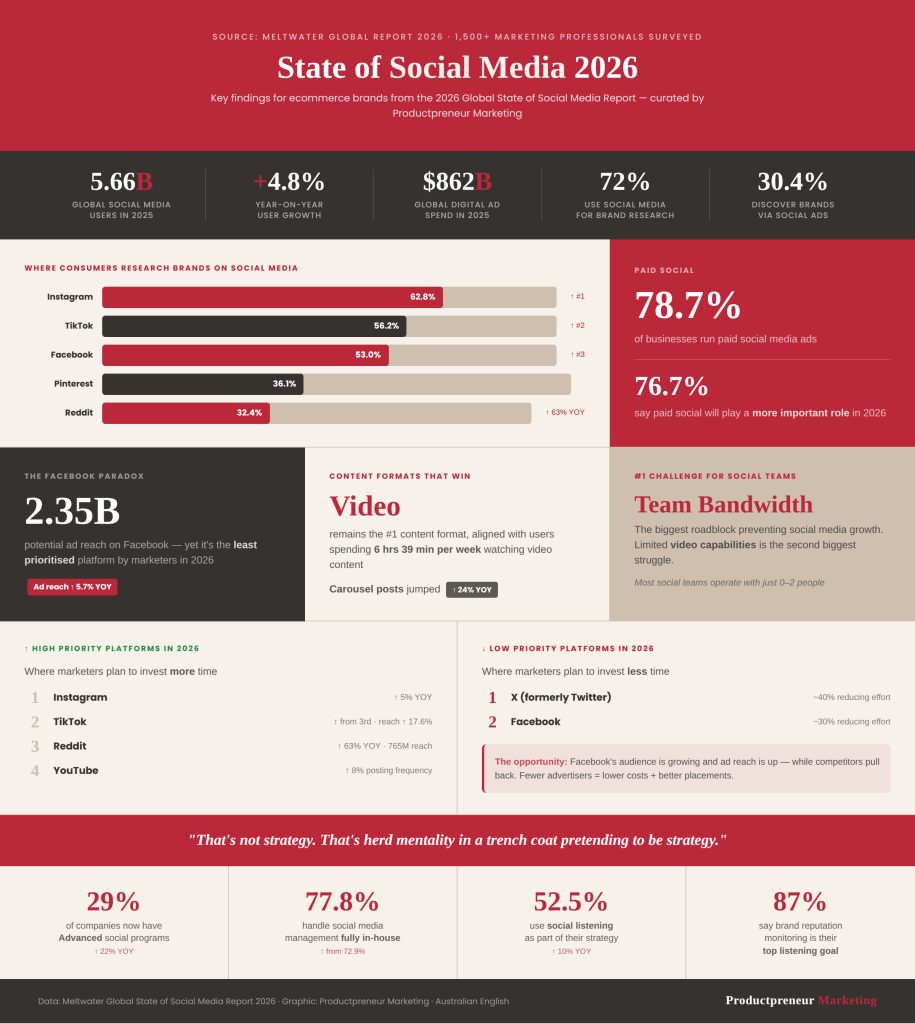
There are now 5.66 billion social media users globally — that’s 68.7% of the world’s population, up 4.8% year-on-year. To put that in perspective, 259 million new users joined social media in the past year alone. That’s roughly the population of Indonesia deciding to open an account.
Global digital ad spend hit $862 billion in 2025, up 9% year-on-year. And 72% of internet users conduct brand research on social media — meaning they’re not just scrolling for entertainment. They’re actively looking for products to buy and brands to trust.
If you’re selling products online, your customers are on social media. Full stop. The question isn’t whether to be there. It’s where to focus — and how to spend your budget wisely.
Which brings us to the part that gets really interesting.
The Great Platform Stampede of 2026
According to Meltwater’s survey, the platforms marketers are most excited about investing in this year are Instagram (increasing 5% year-on-year) and TikTok (which jumped from the third-highest priority in 2025 to second place in 2026, with a 17.6% increase in ad reach). That’s quite the glow-up for a platform that’s been controversial in more than a few boardrooms.
Reddit is the dark horse of the year, with usage surging 63% year-on-year and potential ad reach hitting 765 million. YouTube is seeing an 8% bump in posting frequency. Video, as a content format, remains king — with the average user watching 6 hours and 39 minutes of short and long-form video content per week.
All of this makes sense. New platforms, new formats, new audiences. Marketers love new things. (Honestly, we’re like magpies with budgets.)
But here’s where it gets interesting. The two platforms that marketers are least interested in investing in? X (formerly Twitter) and Facebook.
Facebook. The platform with 2.35 billion people on it. That Facebook.
Marketers are swiping left on it faster than a bad Hinge date with a fish photo.
The Facebook Paradox
Here’s what makes this so fascinating. The Meltwater report doesn’t actually explain why marketers are deprioritising Facebook. There’s no data point that says “performance is declining” or “users are leaving.”
In fact, the data says the exact opposite.
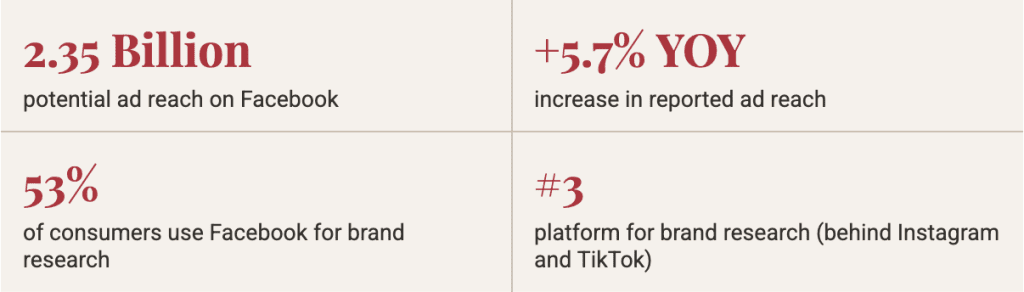
So let’s get this straight: a platform where the audience is growing, the reach is increasing, and more than half the users are actively researching what to buy… and businesses are leaving?
That’s not strategy. That’s herd mentality in a trench coat pretending to be strategy.
Even Meltwater themselves flag this, writing in the report that “before continuing to de-prioritise Facebook, businesses should consider the fact that the platform has actually seen a 5.7% increase in reported ad reach YOY.”
Why This Keeps Happening
If you’ve been in ecommerce for any length of time, you’ll recognise this pattern. A platform becomes “old news.” Everyone gets excited about the next thing. The marketing industry collectively decides that the legacy platform is over, and the cool kids move on.
We saw it with email marketing in the 2010s. (“Email is dead!” Meanwhile, email consistently delivers the highest ROI of any marketing channel.) We saw it with SEO when social media first took off. (“Why bother with Google when you can just post on Facebook?” Oh, the irony.) And now we’re seeing it with Facebook itself.
The pattern always follows the same script:
- A new platform gets hot (TikTok’s rise, Reddit’s 63% surge)
- Marketing publications pile on (“10 Reasons You NEED a TikTok Strategy in 2026!”)
- Budgets shift to the new platform, often without evidence that it’s actually the right move for that specific business
- The “old” platform becomes less competitive — which is precisely when it becomes more valuable for those who stay
It’s the marketing equivalent of everyone cancelling their gym memberships in February. The equipment’s all yours.
What This Actually Means for Premium Ecommerce Brands
If you’re running a premium ecommerce brand — particularly one that refuses to compete on price — this Facebook exodus is genuinely good news. Here’s why.
1. Lower Competition = Lower Costs
When advertisers leave a platform, they take their budgets with them. That means fewer businesses bidding on the same ad placements. Fewer businesses competing for the same eyeballs. The basic economics of paid advertising mean that when competition drops, so do your costs per impression and costs per click.
The Meltwater report shows that 78.7% of businesses still run paid social media ads, and 76.7% say paid social will play a more important role in 2026. That means paid advertising isn’t going anywhere — but where that spend goes is shifting. And the brands who stay on Facebook while others leave are going to benefit from better placements at lower prices.
2. Your Customers Are Still There
Let’s be clear about something: marketers deprioritising Facebook is not the same as consumers leaving Facebook. The report shows that 53% of consumers still use Facebook specifically for brand research — putting it third behind Instagram (62.8%) and TikTok (56.2%).
That’s more than half the users actively looking for brands and products to buy. On a platform with 2.35 billion people. The maths is not complicated.
And here’s the thing about Facebook’s user base that matters particularly for premium brands: the demographics skew slightly older, slightly more affluent, and slightly more intentional in their purchasing behaviour than TikTok. These are exactly the kind of buyers that premium ecommerce brands want to reach.
3. Facebook’s Advertising Infrastructure Is Unmatched
Whatever you think about Meta as a company (and opinions vary, shall we say), their advertising platform is still the most sophisticated self-serve advertising system in the world. The targeting capabilities, the machine learning optimisation, the retargeting options, the creative testing tools — nothing else comes close for ecommerce brands.
TikTok’s ad platform is improving rapidly, but it’s still catching up. Reddit’s advertising options are relatively basic. And Instagram, while excellent, runs on the same Meta infrastructure anyway — so if you’re already running Instagram ads, you’re essentially leaving half the opportunity on the table by not extending to Facebook as well.
4. The “Bandwidth Problem” Is a Clue
The Meltwater report identifies team bandwidth as the number one challenge preventing social media growth, with most social teams operating with just zero to two people. The second biggest challenge? Limited video capabilities.
This tells us something crucial: marketers aren’t necessarily deprioritising Facebook because the data says they should. They’re doing it because they don’t have the bandwidth to be everywhere at once, and when forced to choose, they’re chasing the perceived excitement of newer platforms.
That’s an important distinction. It’s not that Facebook doesn’t work. It’s that small teams are making triage decisions, and Facebook is the one getting deprioritised because it feels “safe to ignore.”
(Spoiler: it’s not safe to ignore.)
What Smart Premium Brands Are Doing Differently
The brands we work with at Productpreneur Marketing don’t chase platforms. They follow the data.
And the data right now says something very clear: don’t abandon Facebook just because other marketers are. Instead, lean in strategically.
Here’s what that looks like in practice:
Run Meta ads across both Facebook and Instagram simultaneously. Meta’s own system is optimised to distribute your spend where it performs best across both platforms. Cutting off Facebook means you’re asking the algorithm to work with one hand tied behind its back.
Invest in video content — but don’t neglect carousel posts. The Meltwater report shows carousel posts jumped 24% year-on-year, which makes sense: they’re perfect for ecommerce brands wanting to showcase multiple products or tell a visual story. And they perform particularly well on Facebook.
Focus on storytelling over discounting. The report confirms that brand awareness remains the number one goal for social media (for the third year running). Yet too many ecommerce brands default to promotional content that only appeals to bargain hunters. Premium brands that tell compelling stories — about their values, their craftsmanship, their customers’ experiences — are the ones building lasting brand equity.
Don’t ignore what’s coming. The report also notes that 29% of companies now have Advanced social media programs (up 22% year-on-year), and 55% of companies plan to increase their social listening investment. The brands that are maturing their social strategy are getting more sophisticated, not less. If you’re pulling back while competitors are levelling up, you’re going to feel it.
The Bigger Picture: Owned vs. Borrowed Audiences
Here’s where I have to put my “wise marketing mentor” hat on for a moment. (It’s a very stylish hat, for the record.)
One of the most important stats from this entire report isn’t about any specific platform. It’s this: 30.4% of internet users discover brands through social media ads. That’s discovery. It’s not conversion. It’s not loyalty. It’s the top of the funnel.
Social media — whether it’s Facebook, Instagram, TikTok, or the next platform we haven’t heard of yet — is borrowed land. You don’t own your audience there. You’re renting access to them.
The smartest premium brands use paid social advertising to drive discovery and initial engagement, then move those potential customers onto owned channels: their email list, their SMS subscribers, their website. That’s where the real relationship-building happens, and that’s where the long-term profitability lives.
Facebook is a brilliant discovery engine for premium products. But it’s step one, not the whole journey. The brands that understand this — and invest accordingly — are the ones building sustainable, profitable businesses rather than just chasing vanity metrics.
The Bottom Line
The Meltwater 2026 State of Social Media report paints a clear picture: social media is bigger, more complex, and more competitive than ever. Marketers are spreading thinner, chasing more platforms, and making triage decisions based on perception rather than performance.
Facebook has become the platform equivalent of that restaurant everyone says they’ve “moved on from” — while the people who still go there keep getting a table immediately, receiving excellent service, and having a wonderful meal. Because there’s no queue.
If you’re a premium ecommerce brand, this is your moment. Not to go all-in on Facebook at the expense of everything else. But to recognise that the platform your competitors are abandoning still has 2.35 billion users, growing ad reach, and more than half its audience actively researching brands.
That’s not a platform in decline. That’s a platform where the smart money is about to get a much better deal.
Want help making the most of this opportunity?
If you’d like a team that understands premium brand positioning managing your Meta ads — so you can focus on running your business — book a free Brand Growth Strategy Session and let’s talk.
Book Your Free Strategy Session ?
P.S. Want to see where your biggest growth opportunities are right now? Try our free Premium Ecommerce Growth Calculator — it takes two minutes and zero commitment.
—
Sources:
Meltwater, Global State of Social Media Report 2026 (1,500+ marketing professionals surveyed)
Kepios / We Are Social, Global Digital Report 2025