Productpreneur Marketing
Where Premium Brands Come To Grow


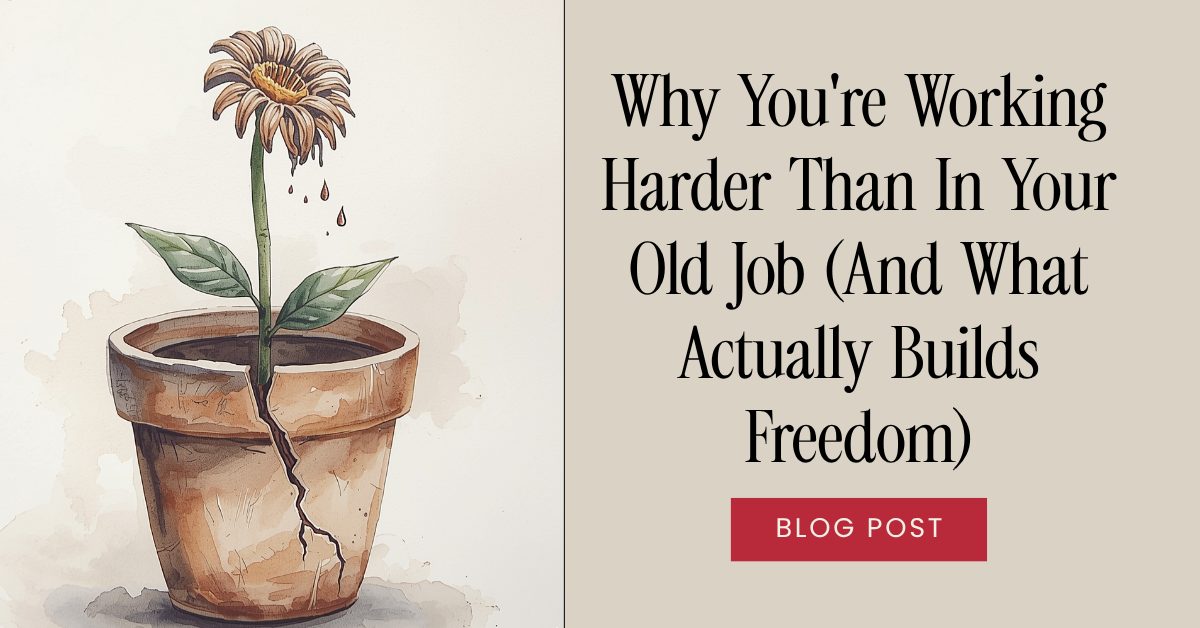
Why You're Working Harder Than In Your Old Job (And What Actually Builds Freedom)
The trap almost every premium brand founder falls into
If you’re running a premium eCommerce brand and you’ve quietly noticed you’re working harder, longer hours, and with less freedom than you used to have at your old corporate job – you are not alone. You are also not failing.
There’s a particular trap that almost every premium brand founder falls into somewhere between year two and year four of running her business. Most of the founders I talk to assume they’re the only one experiencing it. Most of them assume it’s their personal failing – that if they were just more disciplined, more focused, better at marketing, more naturally entrepreneurial, the work wouldn’t feel this hard.
The truth is that this experience is structural. It happens to almost every premium brand founder. It has nothing to do with your ability, your discipline, or your business acumen. And while there’s an entire industry of advertising exploiting this pain right now – build a multi-seven-figure business in 90 days using AI and three hours a day at the beach – the real route out is genuinely available. It just looks different from what you’ve been told.
This article is about why this happens to almost every premium brand founder, and what actually fixes it. Not a tactical fix. A structural one.
What you actually wanted when you started your business
Most premium brand founders started their businesses for two reasons, both of them legitimate.
The first was that you had a product or a brand or a creative project you wanted to bring into the world. Something you cared about. Something with your thumbprint on it. Something that wouldn’t exist unless you made it exist. The making was meaningful to you.
The second was that you wanted more freedom and flexibility than the structured world of employment was offering. School pickups. Doctor’s appointments. The ability to design your own week. To not have to ask permission to take a Friday off. To work in the time of day when you were actually most clear-headed.
That’s the founder’s original deal with herself. Meaningful work, plus freedom over your time. Two things together. Both reasonable. Both important.
The problem is that somewhere in year two or year three, a lot of premium brand founders look up and realise that neither part of the deal is working out the way they imagined.
How the deal stops working
The product is fine. Sometimes it’s even doing well. But you’re not really spending your time on it anymore. You’re spending your time on marketing. On invoicing. On customer service. On the website breaking. On the ads that aren’t converting. On the email that didn’t quite say what you meant. On Instagram captions you’ve rewritten four times.
And the freedom you came for? Worse than it was at the old job. Working evenings. Working weekends. Holding the whole business in your head at all times. Quietly resentful of friends who clock off at five.
You think about marketing in the shower, at the school pickup, at 11pm in bed. The thinking isn’t productive – it’s a low-grade hum of “is the campaign working” / “should I have written that caption differently” / “what should I be doing next” that never quite resolves. You make decisions more slowly than you used to. You second-guess copy you wouldn’t have second-guessed two years ago. The Meta Ads dashboard sits unopened for days. The customer survey you’ve been meaning to send has been on your list for three months.
If any of that is familiar – your issue is not your discipline. Your issue is structural.
Why this happens to almost every premium brand founder
Building a great premium brand requires hundreds, eventually thousands, of well-made decisions over years. Decisions about positioning. Products. Customers. Pricing. Channels. Partnerships. Hires. Fires. Brand direction. What to say no to.
The quality of those decisions is the quality of the brand. It’s not built on tactics or growth hacks. It’s built on careful, considered, well-made decisions that compound over years.
And here’s the structural problem. Decisions made by one person, alone, under pressure, while running every other part of the business at the same time, are systematically a little bit worse than decisions made by two informed people sitting down together with proper attention on the problem.
This isn’t a productivity issue – it’s a cognitive one. Two informed minds outperform one informed mind, especially under uncertainty. The decision made in collaboration with someone who knows your business and can press your thinking is better than the same decision made alone at 9pm on a Sunday with no one to test it against.
Here’s where it compounds. If your decisions are systematically ten percent better because you’re not making them alone, your brand is systematically ten percent better. Year after year. But there’s a second compounding effect that nobody is talking about. Decisions made in collaboration don’t live in your head at 11pm. They get carried by two people. You are not the only one holding the strategy. The cognitive load actually drops.
Which means the structural shift to working with a strategic partner isn’t just how you build a better brand. It is also how you get your freedom back.
In every other context where this kind of work gets done well, it’s done by a team. Corporate marketing departments distribute the function across three to seven people. That’s not because corporates are wasteful – it’s because the marketing function is genuinely too cognitively expensive for one person to carry sustainably. In a small premium brand, that work is being done by one person, the founder, on top of everything else. This isn’t a skill gap. It’s a structural mismatch between what the work requires and what one person can sustainably do.
The real route back to your original deal
If marketing is structurally a team’s job, the answer is to share it. Not give it away – you’re still the founder, you’re still the brand, the brand decisions are still yours. But share it. Bring in someone whose actual job it is to carry the cognitive load with you.
What this looks like in practice is what the African proverb calls a village. Not a hundred people. Not a corporate team structure. Not meetings for the sake of meetings.
What it looks like is, at minimum, two informed people thinking together about the most important decisions in your brand. The founder, who holds the brand vision and the customer intuition and the creative direction. A senior strategic partner who holds the marketing strategy and the structural decisions and the cross-channel coordination. That’s the village. Two informed people doing the work together. Plus channel specialists as required for execution.
The practical name we give this at Productpreneur Marketing is Hire a Strategist – a senior marketing strategist embedded in your business: fortnightly strategy meetings, written briefs for whoever runs your channels, the strategic load shared between you and someone who has been in this work long enough to make the decisions confidently.
The point isn’t the offer specifically. The point is the structural shift. The open loops get closed in conversation, rather than in your head. The strategic weight gets carried by someone whose actual job it is to carry it. The work doesn’t disappear, but it moves out of the place in your head where it’s been living rent-free for two years.
That shift – from carrying the marketing alone in your head, to carrying it in a fortnightly meeting with someone whose job it is – is what gets you back to your original deal.
Not the AI-fantasy freedom of doing nothing while a robot builds your business. The real, achievable freedom of doing the part of the business you actually love – the brand, the customers, the creative direction – while someone whose job it is to hold the marketing strategy holds it alongside you.
What this actually looks like
Amanda from Bell Art makes home and gift wares featuring her mother’s original artworks of native Australian flora. Properly beautiful pieces with the kind of provenance you can taste – the artwork is by her own mum, the products are produced locally, the story is genuinely Australian, and the customer base is people who specifically value all of that.
She’s been a partner of ours for several years now. When she first came to us, she was doing what almost every premium founder is doing right now – holding every marketing decision in her own head, working harder than the business should have required, trying her best with Meta and Google ads on her own but not really being a marketing professional. Not living the deal she originally made with herself.
These days she runs what she calls a lifestyle business. Same brand. Less of her in the marketing weeds. In her own words:
“Bell Art has grown consistently each year. The combination of Shopify, Meta, Google, Klaviyo and Productpreneur ensure our monthly sales are increasing reliably, and we are also increasing our product offering. Bell Art moved out of the house and into warehouse premises – plus we now employ staff.
The biggest change for me is how confident I now feel with my marketing. Marketing was a big drain on my time, and while I knew in theory what needed doing, I couldn’t do it all myself. Outsourcing this part has freed up my time to concentrate on other parts of the business.
I feel like I have a full-on marketing department at my disposal. I personally can choose to work, rather than being chained to the desk.”
That last line is the original deal restored. Meaningful work, plus the freedom to choose. In seventeen words.
Amanda just had her biggest revenue month ever in April 2026. While a lot of premium brands are quietly contracting in the current market, Bell Art is hitting new highs. The reason isn’t a clever tactic or an AI hack. The reason is that consistent, well-made decisions, made over years, in collaboration rather than alone, are the most reliable growth strategy there is. And they happen to also be the route to freedom.
The full Bell Art case study walks through how it actually happened, year by year.
What to do next
If anything in this article has landed for you, here are three things worth doing this week.
Read Amanda’s full case study. The Bell Art case study walks through the actual story of how her premium brand grew over the years, and what’s structurally different about how she runs it now. Worth reading even if you’re not ready to act on anything – it’s the most honest case study we publish.
Book a Brand Growth Strategy Session. It’s a 30-minute conversation where we work out together whether bringing in a senior strategist is the right move for your brand right now. There’s no pitch and no pressure – the call is genuinely useful regardless of whether you go on to engage with us further. Book it here.
Listen to the podcast episode. Why You’re Working Harder Than In Your Old Job (And What Actually Builds Freedom) on The Brand Marketing Show extends this conversation in long form. Search for the show on Spotify, Apple Podcasts, or watch on YouTube.
The deal you originally made with yourself when you started this business – meaningful work, plus freedom over your time – is genuinely available. It just looks different from what most growth advice would have you believe. And it doesn’t require selling out everything that makes your brand premium.