Productpreneur Marketing
Where Premium Brands Come To Grow
WHERE PREMIUM BRANDS COME TO GROW


Why “just sell direct” is bad advice for premium brands (and the best advertising you’re not paying for)
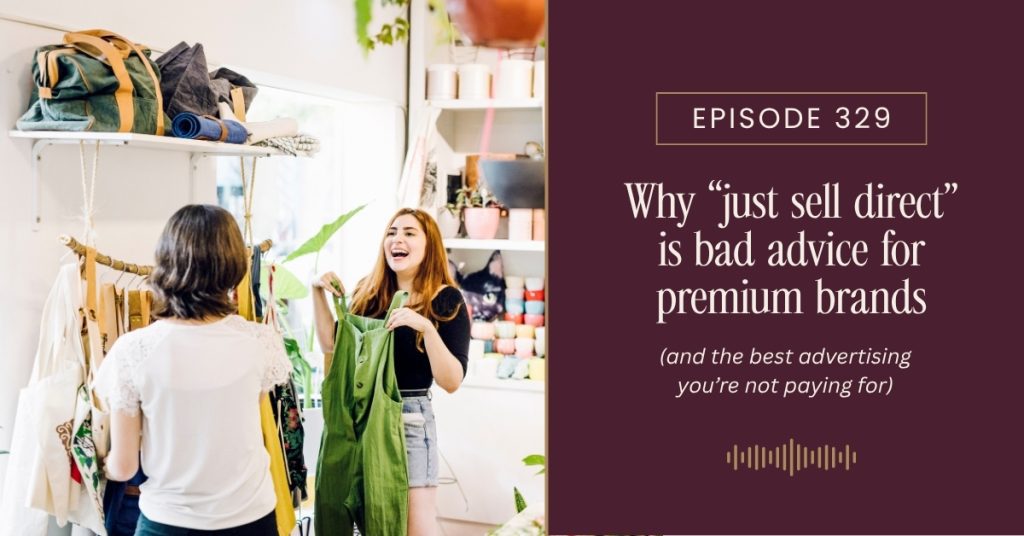
Your best advertising isn’t an ad. It’s someone else’s shelf – and “just go direct” probably talked you out of it.
Everyone is telling premium brands to go direct: cut out the middleman, keep the full margin. And the brands who kept their stockists are often the worst offenders, blasting 30, 40, even up to 80% off online several times a year – undercutting the very retailers championing them at full price, and training their best customers to only ever buy on sale.
In this episode I make the case for the channel most premium brands undervalue. Why the right stockist is some of the best advertising money genuinely can’t buy – a shopfront full of brand-new customers you didn’t pay to acquire. Why direct and wholesale grow each other when you stop competing with yourself (with the Bell Art story of both channels rising together). Why being experience-obsessed is a reason to embrace the right shelf, not avoid it. And how to design your channel mix on purpose – because it’s never “wholesale good, direct bad,” it’s the right mix for your brand.
If your next big online sale is already in the calendar, this is the one to hear first.
Want help designing your channel mix on your real numbers and your real buyer, rather than on a slogan? That’s exactly what a Brand Growth Strategy Session is for. The link is below.
Links mentioned in this episode:
If you’d like help to achieve your goals, I invite you to have a chat to find out how we can make that happen together HERE By booking a Free Growth Strategy
Subscribe & Review in iTunes
Are you subscribed to my podcast? If you’re not, I want to encourage you to do that today. I don’t want you to miss an episode. I’m adding a bunch of bonus episodes to the mix and if you’re not subscribed there’s a good chance you’ll miss out on those. Click here to subscribe in iTunes!
Now if you’re feeling extra loving, I would be really grateful if you left me a review over on iTunes, too. Those reviews help other people find my podcast and they’re also fun for me to go in and read. Just click here to review, select “Ratings and Reviews” and “Write a Review” and let me know what your favorite part of the podcast is. Thank you!
Other Ways To Enjoy This Episode:
Read the Transcript
Last weekend was my birthday. Not a milestone one, nothing with a zero on the end, but my family took me out for lunch anyway, to a lovely little Italian place near us. It’s on one of those streets just near the city – you probably have one where you are – where there’s alfresco dining spilling onto the footpath, cafés and restaurants and bars, a funky hairdresser or two, a bookshop, someone selling artisan chocolate, a handful of independent boutiques. Close to the city, but somehow it’s got this real village feel to it, and it pulls people in all weekend. It’s genuinely lovely.
But I noticed something over lunch that I haven’t quite been able to put down since. There were a few more empty shopfronts than I remembered. A couple too many “for lease” signs in windows that used to have something wonderful in them. And it got me thinking about those shops – the independent boutiques especially – and about how much they actually matter to the brands lucky enough to sit on their shelves. Because a great little shop, the right shop, is doing something for the brands it stocks that those brands very often massively undervalue. It’s not just a place that happens to sell their product. It’s one of the best pieces of advertising they will ever have – and, approached the right way, one of the more lucrative channels they’ve got.
And yet the advice I hear handed to product brands, over and over, points them in exactly the opposite direction. Go direct. Go direct-to-consumer. Cut out the middleman, stop giving away half your margin to a retailer, own the customer relationship yourself. Why on earth would you sell your beautiful product to a shop for half of what it’s worth, when you could sell it yourself, online, and keep the whole lot? It sounds so obvious when you put it like that. More control and more money, in a single clean move.
And here’s the thing – for a certain kind of brand, at a certain moment, it’s genuinely good advice. I’m not here to tell you it’s always wrong. But somewhere along the way it stopped being one option among several and hardened into gospel. “Just go DTC.” It gets handed to every product business, at every stage, as though it’s the answer to everything. And it simply isn’t. For a lot of premium brands it’s quietly the wrong advice, or at the very least dangerously oversimplified advice, and today I want to walk you through why – and what to do instead.
Let me start with the moment this really crystallised for me, because it shows how badly this can go. A while ago I was in a room where a reasonably well-known marketing mentor was giving advice to a group of product brands. And these were brands that sold through stockists – through lovely independent retailers who had championed them, put them on their shelves, introduced them to a whole customer base they’d never have reached alone. And this mentor’s advice, delivered with enormous confidence, was essentially this. Run big discounts direct to your own customers. Drop your online price. Get people buying from you instead of from the shops that stock you.
And I remember sitting there thinking, do you actually understand what you’ve just told them to do? Because you’ve told them to undercut the very retailers who are building their brand for them. To train their own customers to walk past the shops that champion them and come straight to a discount. To quietly sabotage the people carrying their product, all to claw back a slice of margin. That is the “just go direct” logic followed all the way to its natural conclusion, and its natural conclusion is a brand quietly burning down the relationships that were making it.
And here’s the thing – you don’t have to go that far, that deliberately, to do the damage. Most brands doing this aren’t sitting in a room being told to abandon their stockists. They still sell wholesale. They’ve still got their product in lovely shops. They just don’t think about those shops for one second when they fire off the next online promotion. And it’s rarely a polite little twenty per cent, either. It’s thirty, forty per cent off. It’s a discount code to anyone who’ll hand over an email address. And then the really big ones come around – end of financial year, Black Friday – and suddenly it’s “up to eighty per cent off,” splashed across every channel they own. All of it online. All of it quietly undercutting the exact retailers who are out there, right now, selling that same product at full price and putting their own reputation behind it. These brands haven’t dropped wholesale. They’re just competing against it, aggressively, several times a year, without ever quite realising that’s what they’re doing. And it hurts both channels at once – the stockist who can’t possibly match eighty per cent off, and the brand that’s just taught its own customers that full price is for mugs.
So let’s actually examine the myth underneath all of this, because on paper, I’ll grant you, it’s seductive. When you sell direct, you capture the full retail price. When you sell wholesale, you sell to a stockist at roughly half that price, and they mark it up to the customer. So at a glance, direct looks like it’s worth twice as much to you. Full margin versus half margin. Keep the lot versus give away half. Said like that, it’s not even a debate.
Except that headline number – the lovely full retail price you get to keep – hides an enormous amount. And we are going to pull that apart properly next week, with real numbers from real brands, because when you actually run it, the answer genuinely surprises people. So I’m not going to do the maths today. I just need you to hold one idea, loosely, in the back of your mind. The full price you capture selling direct is not the same as the profit you keep. There is a long and expensive gap between the two. Which means “direct earns me double” was never actually true. It just looked true from a distance.
And once you stop believing direct is automatically worth double, wholesale starts to look like a very different proposition – because it does things that selling direct simply cannot do.
Start with reach. A good stockist puts you in front of an entire audience you would otherwise have to pay, handsomely and repeatedly, to reach yourself. Their customers. People who already walk through that door, who already trust that shop, now walking past your product, picking it up, turning it over. You didn’t run a single ad. You didn’t pay for a single click. The retailer’s foot traffic is doing work that would cost you a small fortune to replicate online.
Then there’s simplicity, and I’ve said this before but it genuinely reframes the whole thing, so stay with me. Picture fifty stockists, each placing a five-hundred-dollar order with you every month. Now picture five hundred individual customers, each spending fifty dollars with you online. Same revenue. Twenty-five thousand dollars, either way. But they are wildly different businesses to actually run. The wholesale version is fifty invoices and fifty parcels. The direct version is five hundred parcels, five hundred lots of postage, five hundred pick-and-packs, five hundred customer service emails when something turns up the wrong size. Same money coming in. An enormous difference in the work, and the cost, of getting it.
And then cash flow, which nobody talks about nearly enough. A wholesale order is a meaningful chunk of money arriving at once, on terms, from a customer you did not have to spend a fortune acquiring one click at a time. For a growing brand trying to fund its next stock run, that rhythm of money can be the difference between growing and stalling.
But here is the argument the “just go direct” crowd miss almost entirely, and for a premium brand it’s the one that matters most. For a considered, premium buyer, being stocked in a respected retailer isn’t just distribution. It’s trust. When your buyer discovers you sitting on the shelf of a shop she already knows and loves, that shop’s credibility quietly transfers to you. The retailer is vouching for you, without saying a single word. “We chose to stock this. We put it here, next to the brands we’re known for, the brands our whole reputation rests on.” You cannot buy that kind of endorsement with an ad. An ad is you, telling someone you’re wonderful. A trusted stockist is someone else telling them you’re wonderful – someone with nothing to gain from the flattery and a reputation to protect. And that is worth so much more than anything you could ever say about yourself.
Think about how a premium buyer actually shops, because we’ve talked about this over the last couple of weeks. She encounters you somewhere – an ad, a post, a friend mentions you – and then, before she’ll spend real money on a considered purchase from a brand she’s only just met, she goes looking for reasons to believe you. She checks you out. She wants validation. And one of the single most reassuring things she can possibly stumble across is that a retailer she already respects has chosen to stock you. That discovery does more to close the sale than almost anything you could have told her yourself. So wholesale, for a premium brand, is not the channel you grudgingly tolerate for the volume while the real action happens online. It is actively doing discovery and trust-building work that your direct marketing structurally cannot do on its own.
Which brings me to the fear that stops so many brands leaning into any of this – the deep, nagging fear that direct and wholesale are secretly at war with each other. That every sale you make direct is one you’ve stolen from a stockist. That every stockist you add is eating into your lovely full-margin direct sales. That you’re forever robbing Peter to pay Paul.
A few years ago I sat down on this podcast with Amanda from Bell Art – a beautiful home and giftware brand, built around original artworks of native Australian flora, the kind of thing people fall genuinely in love with. And Amanda had exactly this fear, right in her bones. She worried that if she pushed harder on selling direct to her own customers, she’d cannibalise her wholesale side. That she’d end up competing with the very stockists who had backed her, and everyone would end up worse off. It’s such a reasonable fear. It’s the fear the “just go direct” advice preys on, actually – the idea that the middleman is taking something that’s rightfully yours.
And what actually happened was the exact opposite. Both grew. Her direct sales grew, and her wholesale grew, at the same time, side by side.
The reason is simple once you see it, and it’s the whole point. Good direct marketing doesn’t quietly steal demand off the shelf. It creates demand that then shows up everywhere. When Amanda marketed her brand well – told her story, showed the artwork, built real desire for what she made – some of those people came and bought directly from her, yes. But plenty of others saw it, wanted it, and then went and bought it where they already loved to shop: from one of her stockists. She was never dividing a fixed pool of buyers between two channels that had to fight over them. She was raising the whole tide. She made more people want the thing, and then those people bought it wherever suited them best. Direct and wholesale weren’t two forks stabbing at one small pie. Done properly, direct made the pie bigger, and everyone at the table got more.
But – and this is the rule that makes the entire thing hold together, and it takes us straight back to that mentor in that room – there is one thing you must never, ever do. You must never undercut your own stockists. The moment you start discounting direct, dropping your online price below what your retailers can offer their customers, you break the whole machine. And I’m not talking about the occasional, considered sale. I’m talking about the thirty, forty, eighty per cent off, several times a year, that we started with. You train your customers to skip the shops that champion you and wait for your next big online blowout instead. You make a mug of every retailer who put their reputation on the line to stock you – because how are they meant to compete with the brand itself at eighty per cent off? And you land yourself right back in the discounting death-spiral we keep coming back to on this show, teaching people that your real price is the sale price, quietly dismantling the premium positioning you worked so hard to build. Rewarding genuine loyalty is fine. A considered, occasional sale event is fine. But discounting direct in a way that undercuts the partners building your brand is a slow act of self-harm – and it’s precisely what that mentor was so cheerfully recommending.
So does all of this mean you should race off and sign up every stockist who’ll have you, and pour cold water on your online store? No. Absolutely not. And I want to be really, genuinely clear about this, because it would be so easy to hear this episode as “wholesale good, direct bad” – and that is not even slightly what I’m saying. The point is not that one channel beats the other. The point is that your channel mix should be a decision you make on purpose. Designed. Not defaulted into because someone on a stage told you direct was the only game worth playing.
So how do you actually decide? A few honest questions. Where does your buyer genuinely expect to encounter a product like yours – in a beautiful shop, in her hands, being lifted off a shelf? Or online, on her phone, at eleven o’clock at night? What is your average order value – because a lower-priced product can be brutally hard to make pay when you’re selling it direct on paid traffic, and often genuinely belongs on a shelf where the discovery is free, whereas a high-value, considered piece can comfortably carry the economics of selling direct. What is your actual capacity – could you even service a hundred new stockists if you won them tomorrow? And what does your cash flow really need right now? Those answers decide your mix. Not a slogan. Not what happened to work for some completely different brand, with a completely different product, and a completely different buyer.
Let me make one of those a bit more real for a second, because it’s the one brands undervalue the most. Think about the last time you discovered a brand you now love, in a shop. Not online – in an actual shop. You were browsing, not really looking for anything in particular, and something caught your eye. You picked it up. And there’s a particular feeling in that moment, isn’t there – a little private thrill of “oh, what’s this.” You turn it over, you read the story on the back, you notice the care in how it’s made. Nobody targeted you. No ad chased you around the internet for a week. You found it – and because you found it, in a shop you already trusted, it felt like yours. Like a discovery you made, not a sale someone made to you. That feeling is worth an absolute fortune, and it is almost impossible to manufacture online. And every single brand on that shelf is getting it, for free, every single day the shop is open.
And here’s a way to actually put a number on that, because “it’s good for the brand” is so easy to wave away. Think about what it costs you to create just one moment of discovery online. To get one brand-new person, who has never heard of you, to stop, pay attention, and seriously consider you – you’re paying for the ad, and you’re paying for the click, and for a considered premium product most of those people still don’t buy on the first visit. By the time you’ve actually acquired one genuine new customer through paid ads, you might be paying fifty, eighty, well over a hundred dollars for that single introduction – I have seen it sit north of a hundred dollars a customer more often than you’d think. Now walk back into that lovely shop. Every single person who wanders in and encounters your product on the shelf is having that exact same moment of discovery – a brand-new introduction to your brand – and you paid nothing for it. The shop did. Their rent, their lease, their staff, their years of building that foot traffic. So a stockist placing an order with you every month isn’t just buying product from you. They are handing you a shopfront full of brand-new introductions that you would otherwise be paying through the nose to buy, one expensive click at a time. That is the part the “keep your full margin, go direct” maths never, ever counts.
Now, does that mean direct-only is always a mistake? Not at all. There are absolutely brands for whom direct-only is the right answer, entirely on purpose. Brands built on deliberate scarcity, where being everywhere would genuinely cheapen the thing. Brands whose whole model lives on owning the customer relationship and the data directly, because the repeat purchase and the lifetime value is where they actually make their money. For those brands, staying direct is a smart, considered strategy – not a failure to “graduate” to wholesale.
But I want to knock one very common belief on the head while we’re here, because it’s the reason a lot of premium brands wrongly rule wholesale out. There’s this idea that if your brand is really special, really considered, you have to keep it direct to protect the experience – that the moment it lands on someone else’s shelf, you’ve lost control of everything you’ve so carefully built. And I just don’t buy it. Because a beautiful shop, the right shop, is not where you lose the experience. It is the one place you get all of it at once. Online, you’re working with sight, and a little bit of imagined touch, and that is your lot. In the right shop, with packaging you have designed with real love, your customer picks the thing up. She feels the weight of it in her hand. She hears the rustle of the tissue. She catches the scent of it. She sees it in beautiful light, sitting next to brands that make it look even better than it does on its own. That is not a watered-down version of your brand experience. For most premium brands, it is the richest, fullest version there is – every sense engaged, all at once, in a way a screen simply cannot do. So no – being experience-obsessed is not a reason to avoid shelves. Choose the wrong shop and yes, you’ll cheapen it. Choose the right one, and it is the best possible stage your product will ever get to stand on.
Which is, in the end, the whole message of today. Choose your channels on purpose, for your brand, your buyer and your real economics – not because “just go direct” happens to be the advice everyone’s repeating this year. Because “just go direct” is the same shape of bad advice as “just crack this one thing and you’ll finally scale.” It’s a comforting simplification, dressed up as a strategy. And the real answer is less exciting and far more useful: a channel mix you have designed deliberately, where direct and wholesale compound each other instead of quietly competing, and where you never, ever undercut the partners helping to build your brand. Wholesale isn’t the answer. Direct isn’t the answer. The right mix, chosen on purpose for your particular brand, is the answer.
And that brings me back to my little village street, and those empty shopfronts. Because those independent shops are worth so much more to the brands they stock than most of those brands will ever quite appreciate – not just as a place to sell, but as some of the best advertising and validation that money genuinely can’t buy. The smart brands know it. And they would never, ever dream of undercutting the very shelves that are out there, quietly building them.
So next week, I’m going to make every bit of this concrete, with real numbers from two real brands. And one of them is a brand that had steered almost entirely away from wholesale, completely convinced there was more profit in selling online – and found out, once we actually ran the numbers, that it was nowhere near that simple. If you have ever made a channel decision based on a gut feeling about where the money surely must be, next week is the episode to hear before you make your next one.
And if you’d like some help designing your own channel mix properly – on your actual numbers, for your actual buyer, rather than on a slogan someone handed you from a stage – that is exactly what a Brand Growth Strategy Session is for. The link’s in the show notes. I’ll see you next week.