For Premium eCommerce Brands Tired of Guessing What to Write — and Discounting When It Doesn't Work
How to write content that converts at full price.
Extract your content strategy from the customers you already have — without guessing, copying, or discounting.
You're writing the captions, drafting the emails, briefing the ad creative — and quietly hoping you're saying the right things to the right people.
When the hope doesn't pan out, the fallback is almost always the same: run a sale. Discount the new range. Offer a code. It moves units in the short term — and it quietly trains your customers to wait, erodes your margin, and signals to the market that your full price is negotiable. None of which is sustainable for a brand built on craft, quality, and considered positioning.
The brands writing content that genuinely converts at full price aren't more talented, better resourced, or running better promotions. They're working from documented customer intelligence — the exact language, the specific objections, and the aspirational future their customers are moving toward. That's a methodology. And once you have it, you stop guessing what to write and you stop needing the discount to compensate.
The Customer Intelligence Survey is how you build that methodology — and the whole thing is designed to be deployed in a week and analysed in an afternoon.
- 📥 Two done-for-you survey templates — copy directly into Typeform or Google Forms and deploy this week
- ⚡ Klaviyo automation setup — make customer intelligence permanent infrastructure in 30 minutes, not a one-off project
- 🤖 AI Prompt Pack — 20 ready-to-use prompts that turn your survey responses into FAQ priorities, content topics, product page copy, and ad hooks in an afternoon
- 📅 90-day Content Map template — every insight from your data already mapped to its content output, sequenced by priority
- ✅ No analytical guesswork — the methodology tells you exactly what your data means and what to do with it
Instant access · $197 $47 · Introductory price
Let's talk about what's actually keeping your content from converting.
You've built a brand worth caring about. You've invested in the photography, the packaging, the founder story. Your customers love you when they find you. The brand looks every bit the premium operator it actually is.
And then you sit down to write the next email. The next ad. The next product page rewrite. And there's a moment — every single time — where you're not quite sure what to say. So you draw on instinct, on what you'd want to read, on what's worked for competitors you admire, on what a marketing newsletter suggested last week. You guess. Carefully and with experience, but you guess.
Sometimes the guess lands. Often it doesn't. And when it doesn't, the fallback is almost always the same: a sale. A discount. A promo code. Something to move units that the messaging couldn't move on its own. It feels like a recovery — and in the short term it is. But it's also quietly training your customers to wait for the next sale, eroding the margin that funds everything else, and signalling to the market that your full price is negotiable.
The brands writing content that genuinely converts at full price aren't more talented than you. They're not better resourced. They're not running cleverer promotions. They've simply built the intelligence layer that everything else flows from — and they've stopped guessing because they no longer need to.
The Customer Intelligence Survey is the methodology for building that layer. Four focused modules. Five practical resources. An AI Prompt Pack that turns survey data into deployable content in an afternoon. And the kind of clarity about your customer that means your next sale will be the last one you run because the messaging finally is working.
Where most brands are getting their customer intelligence right now.
None of these are wrong. They're just incomplete — and the gap between what they tell you and what your customers actually think is exactly the gap your content strategy is currently sitting in. The gap a sale, a discount, or a 20% off code keeps temporarily papering over.
Your own assumptions
You've been in your business long enough to feel like you know your customer. And you do — partially. But your assumptions reflect who you wish your customer was, who you started building for, and who you've spent the most time speaking with. The actual distribution across your customer base looks different from what you'd guess. Sometimes dramatically so.
→ Founder intuition is a starting point, not a strategy
Competitor copy
You're studying competitor ads, scrolling competitor feeds, screenshotting hooks that work in your category. Useful, until you realise that hook worked for their customer because it was built on their customer intelligence — and you're borrowing the format without the substance that made it convert.
→ Borrowed playbooks rarely fit the brand using them
Satisfaction surveys
The NPS scores look great. The average star rating is climbing. And you don't have a single line of next month's blog post, FAQ priorities, or product page rewrite that the survey told you to write. Satisfaction data answers a different question — one that doesn't translate into content strategy.
→ 4.6 stars tells you what's working. It tells you nothing about what to write next.
The marketing newsletter
The new hook formula. The trending angle. The platform play of the moment. Every week another input that suggests if you'd just change the tactic, things would shift. The advice is sometimes good. It's also, structurally, what everybody else in your category is reading and doing this week.
→ Generic tactics applied to specific audiences produce generic outcomes
Customer reviews
The five-star reviews tell you what your most enthusiastic customers love. They're real signal — but they're a sliver. The customers who almost didn't buy, who bought once and didn't return, who considered you and chose someone else? They're not reviewing you. The intelligence you most need lives in the conversations you're not having.
→ Your most engaged voices aren't your full audience
A documented survey methodology
Multiple choice questions with psychographically coded answer options. Sent at the post-purchase golden window. Decoded using pattern analysis, not anecdote. Translated into FAQ priorities, content topics, product page rewrites, and a brand voice grounded in your customers' own language. The intelligence layer your competitors don't have — because almost nobody has built it.
→ This is what the course teaches you to deploy
Real Brands. Real Intelligence. Real Results.
The Customer Intelligence Survey isn't theoretical. It's the same methodology we run inside our agency with premium brands across Australia, New Zealand, and the US — and it's what gives our content and growth strategy its foundation. Here's what it surfaced for two brands, and what happened after.
The methodology in action
Two questions. One pattern. An entire content strategy rebuilt.
When we surveyed Indagare Beauty's customer base, two questions in sequence revealed the pattern that transformed the brand's marketing.
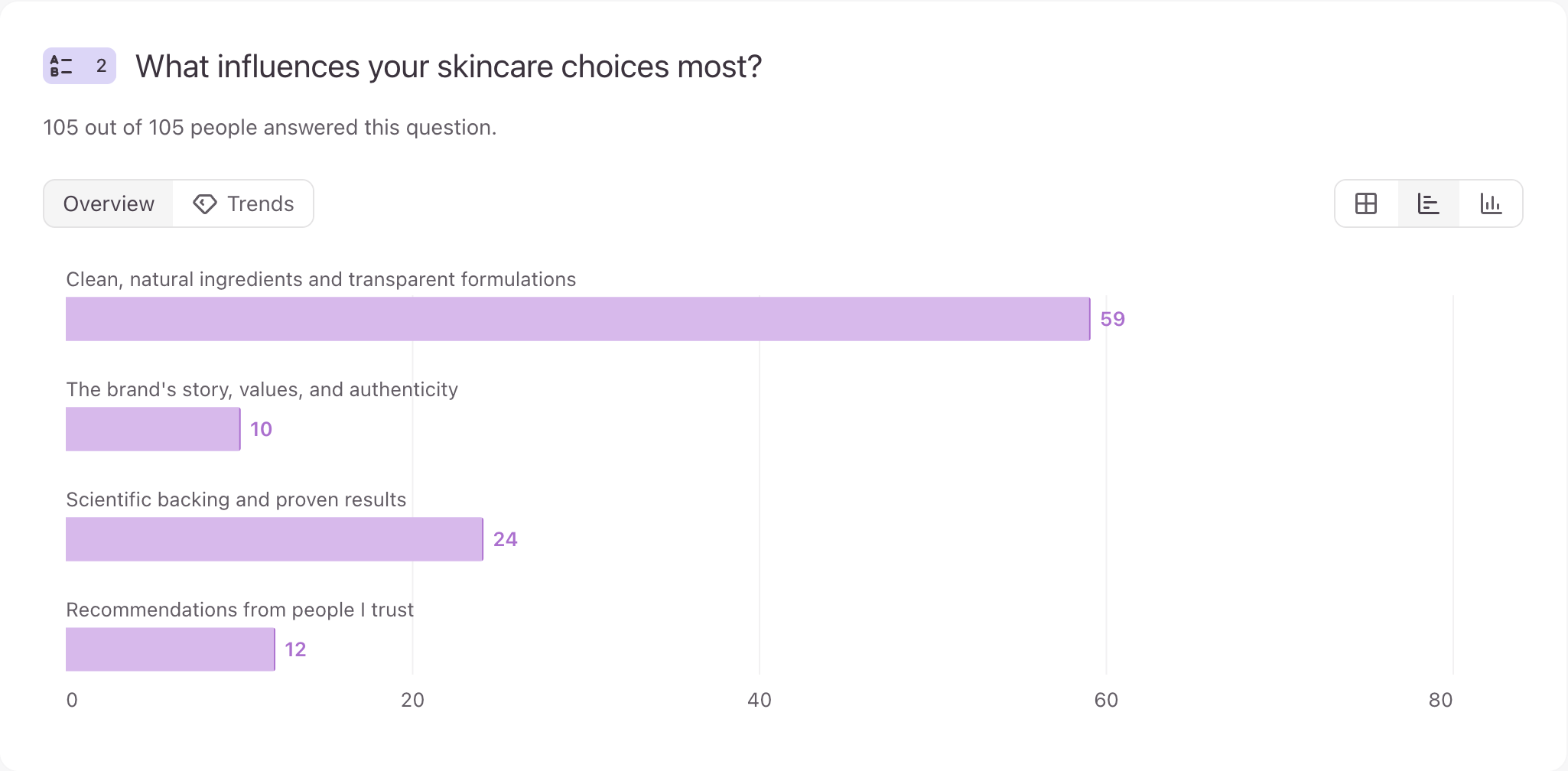
Survey Question 2
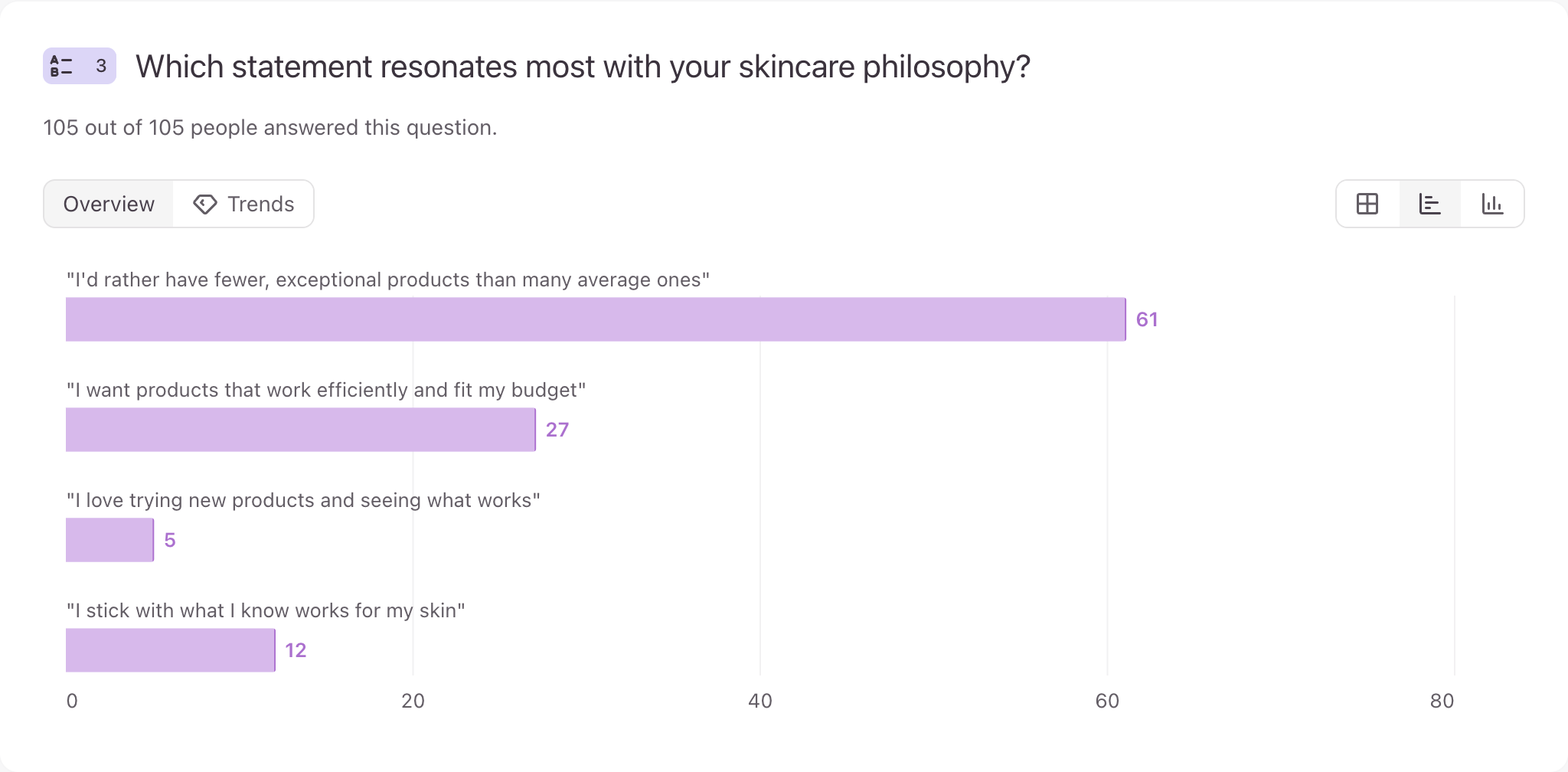
Survey Question 3
Read separately, each question is interesting. Read together, they're a strategy.
Indagare's customer base isn't just sustainability-led. It's a customer who wants clean, transparent, exceptional products and is buying fewer of them. That's a customer the brand had been talking to with promotional emails, new product launches, and discount-led campaigns — all the things that work for a different kind of buyer.
The marketing strategy was rebuilt around what the two questions revealed together. Content stopped chasing novelty and started leading with ingredient transparency, formulation craft, and the considered ritual of a smaller skincare routine. Email frequency dropped. Promotional language disappeared. Hero copy across every channel reframed around quality over quantity.
One survey. 105 respondents. A documented shift in direction that informed every piece of content from that point forward.
Indagare Beauty — Premium Skincare
+282% revenue growth in 12 months.
The survey ran first. The content strategy was then rebuilt around what it surfaced — the language, the values, the aspirational future Indagare's customers were moving toward. Ads, emails, organic content, product pages: all informed by documented intelligence rather than founder intuition.
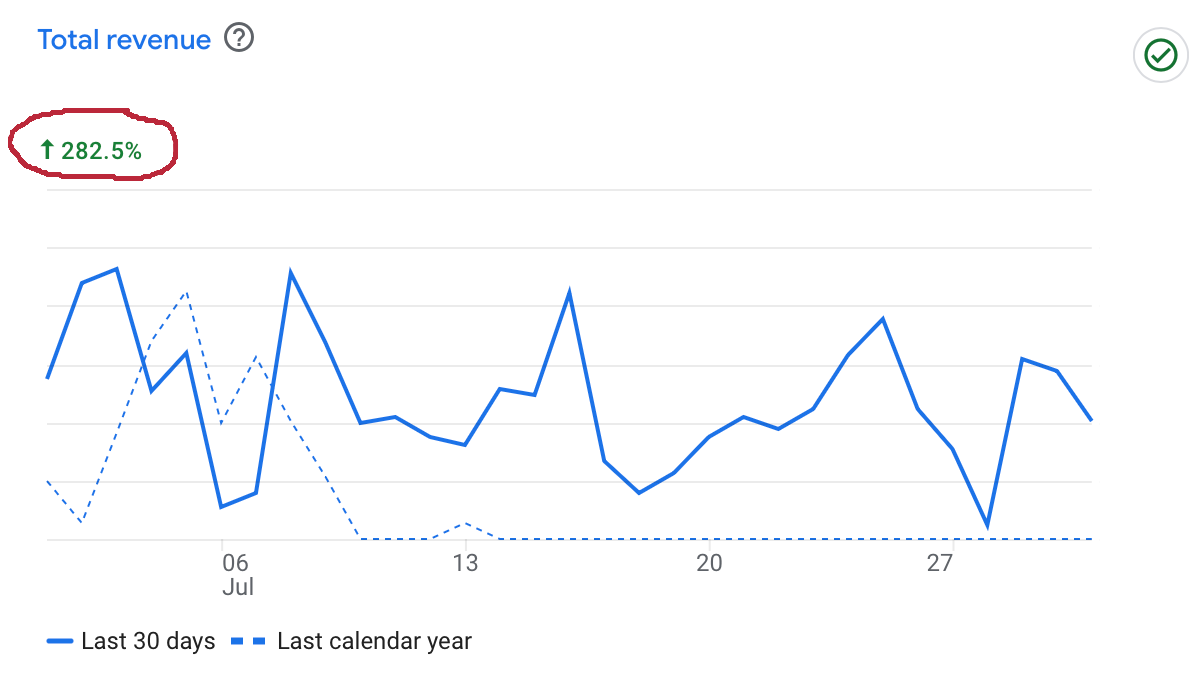
Indagare Beauty — 12-month revenue growth
Result: 282% revenue growth in the 12 months that followed — the business nearly tripled.
The survey wasn't the only thing that changed in the business. But it was the intelligence layer that informed everything else.
Alaska Fresh Seafood — Premium Wild-Caught Seafood
+110.3% revenue growth in 9 months.
Adra and Juro's customer base looked, on paper, like price-sensitive shoppers. The survey told a different story. 245 responses surfaced that only 14.8% of their customers were leading with price — while 49.2% led with quality and freshness, and 79.2% said sustainability was very important or essential.
That single finding reshaped the entire strategy. Instead of competing on price, the new website led with quality assurance, sourcing transparency, and the relationships behind the fishermen who actually caught the seafood. The Klaviyo flows mirrored the same hierarchy. Ads running alongside it all spoke directly to the language the survey had surfaced.
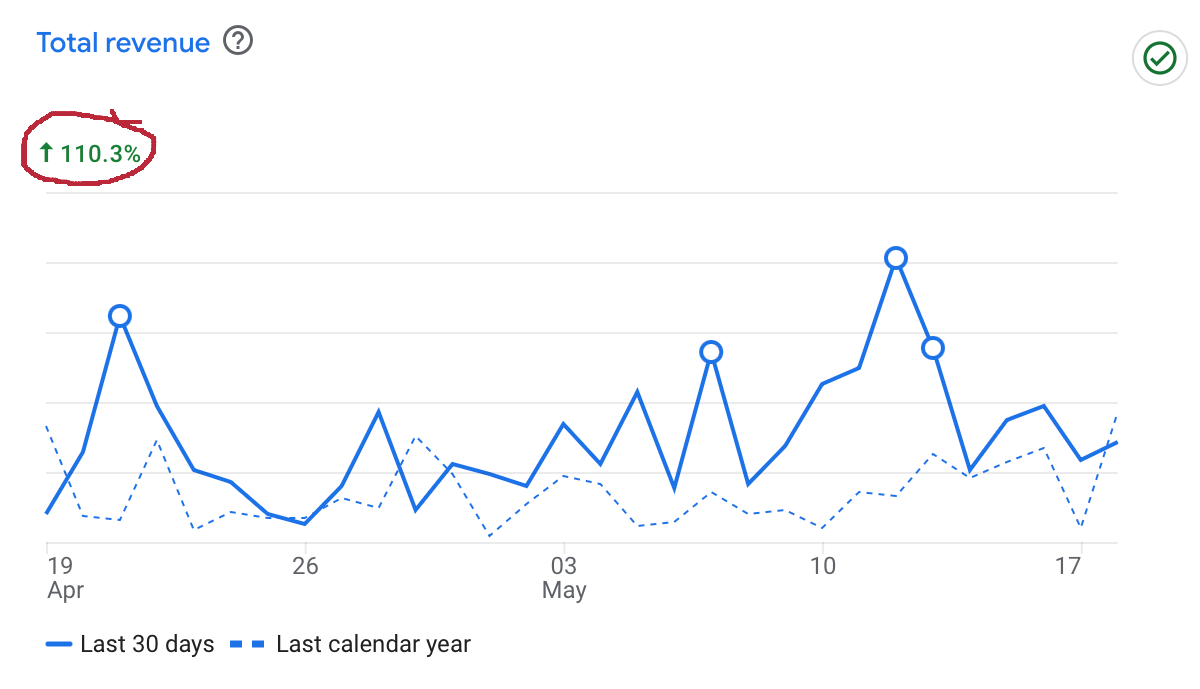
Alaska Fresh Seafood — 9-month revenue growth
Result: 110.3% revenue growth in the 9 months that followed — the business more than doubled.
The survey didn't do the work alone. It told the team exactly what work to do — which is the difference between a website rebuild that lifts the needle and one that doesn't.
What happens when you write content that earns the sale at full price.
You stop borrowing hooks. You stop testing creative that "should" work. You stop running another promotion to compensate for messaging that isn't quite landing — because the messaging finally is.
Introducing: The Customer Intelligence Survey
A focused, deployable methodology for premium eCommerce brands who want to stop guessing — and start building content strategy from documented customer intelligence.
- Why most brand surveys waste everyone's time — the foundational distinction between satisfaction data (which tells you nothing about what to write) and insight-mining (which rebuilds your content strategy from the inside out), and why almost every survey you've ever sent or received was the wrong kind
- How to design questions whose answer options are doing analytical work — the psychographic coding methodology that makes the pattern of customer responses reveal the underlying values, motivations, and barriers across your entire audience, without your respondents having any idea that's what's happening
- The four intelligence categories every survey needs to cover — Values & Identity, Motivation & Priority, Barriers & Hesitation, and Aspiration — and how each one feeds a different layer of your content and marketing program
- Two complete done-for-you survey templates — one in a premium/sophisticated voice, one in a warm/playful voice — that you can copy directly into Typeform or Google Forms and deploy this week
- The post-purchase golden window and Klaviyo automation — why the 7–14 day window after first purchase produces your richest data, and how to set up the automated flow that makes customer intelligence a permanent piece of your infrastructure
- How to read your responses without being misled by outliers — the frequency-first analytical method, the four-level Value Statements exercise, and the customer language audit that turns raw survey data into a documented brand voice
What's Inside
Four focused modules covering the full intelligence cycle — from why most surveys fail through to deploying the analysis as content strategy. Approximately 60–75 minutes of training, designed to be implemented over four weeks rather than consumed in one sitting.
Why Most Surveys Fail, and the Insight-Mining Reframe
12 minsThe foundational shift in how to think about customer surveys. The decisive distinction between satisfaction data and insight-mining. Why the word "survey" itself is killing your response rate. A worked before-and-after example — same 45 customers, two completely different outcomes — that crystallises what changes when you design the survey correctly.
Designing Your Survey: Questions, Options & Brand Voice
20 minsThe heart of the methodology. The four intelligence categories every survey needs to cover. Psychographic coding — the invisible analytical layer inside your answer options. The qualifier question that filters irrelevant respondents. Two fully decoded real survey examples in completely different brand voices, so you see exactly how the methodology adapts to your brand.
Getting Responses: Distribution & Timing
15 minsThe practical module. The post-purchase golden window and Klaviyo automation. Subject lines that work and the two phrases that quietly kill open rates. Incentive design — what works, what doesn't, and the type that distorts your data in ways you can't detect. The no-list method for early-stage founders.
Reading the Pattern: From Responses to Content Strategy
18 minsThe payoff module. The cardinal rule of multiple-choice analysis. The frequency tally and the worked 71%/13%/11%/4% example that shows exactly how one question's distribution can reshape an entire content program. The four-level Value Statements exercise. The customer language audit. The 90-day Content Map that turns insights into a documented action plan.
Five Practical Resources Included
Every module comes with a tool that does the implementation work. No templates sold separately. No upsells inside the course.
RESOURCE 01
Survey Design Workbook
Used alongside Module 2. Walks you from brand and audience definition through to a pre-launch checklist. Includes the four intelligence categories planner, qualifier-design exercise, psychographic coding worksheet, and brand voice audit.
RESOURCE 02
Done-for-You Survey Template
Both complete surveys, fully written. Version A in premium/sophisticated voice. Version B in warm/playful voice. Ready to copy directly into Typeform or Google Forms with bracketed placeholders for your details.
RESOURCE 03
AI Prompt Pack & Content Map Template
20 ready-to-use prompts that turn your survey responses into FAQ priorities, content topics, product page copy, and ad hooks in an afternoon. Includes the complete Content Map Template with a 90-day priority grid. This is the resource that turns intelligence into deployable content fastest.
RESOURCE 04
Survey Distribution Playbook
Four email templates (invitation, reminder, thank-you, re-engagement), the Klaviyo flow setup checklist, both no-list methods written out as step-by-step processes, and the response tracking log.
RESOURCE 05
Response Analysis Workbook
Frequency tally sheet pre-formatted for up to eight questions, dominant pattern analysis section, content mapping table, four-level Value Statements exercise, and customer language audit.
This is exactly for you if...
- You have an existing customer base — even a small one — and you've never extracted structured intelligence from it
- You're writing content that feels on-brand but isn't quite converting, and you suspect you're guessing at what your customers actually care about
- You're running discounts more often than you'd like, to compensate for messaging that isn't quite landing at full price
- You're preparing for a rebrand, a product launch, or a significant marketing investment and you need to get your messaging right the first time
- You want a methodology you can run once and then again next year — building a longitudinal record of how your customers evolve
- You're tired of borrowing competitor hooks and ready to build copy that's grounded in your own customer's words
- You want an analytical method, not a marketing platitude — and you're willing to do an hour of focused analysis to extract the value
This probably isn't for you if...
- You have no customers yet and no email list — the course covers a no-list method, but the majority of the methodology assumes an existing customer base
- You're competing primarily on price — this methodology is built specifically for premium, values-led positioning
- You want a generic NPS or satisfaction survey template — that's not what this is
- You're looking for a done-for-you service (this is a self-implementation training)

Meet Your Guide
Hi, I'm Catherine — and I've watched too many beautiful brands write content their customers weren't asking for.
At Productpreneur Marketing, we work exclusively with premium, sustainable, and founder-led eCommerce brands. The kind of brands that take quality seriously, take values seriously, take their customers seriously — and end up, often despite all that care, writing content that doesn't quite land.
The pattern I see, over and over, is this: a brand built with genuine craft and intention, writing captions and emails and product page copy grounded in what the founder thinks the customer wants to hear. Sometimes the founder is right. Often they're partially right. Almost never are they fully right — because the actual distribution of values, motivations, and barriers across a real customer base is more nuanced than any one person's intuition.
The Customer Intelligence Survey methodology is what we've built and refined inside the agency over the last several years — and what I've now packaged into this course. It's the same methodology that has powered content strategy refreshes, brand repositioning work, FAQ rebuilds, and product page rewrites for premium brands across Australia, New Zealand, and the US.
This is the intelligence layer the brands writing content that actually converts have already built. Now you get to build yours.
Ready to write from documented intelligence?
Get instant access to all four modules and the five implementation resources.
Instant Access
The Customer Intelligence Survey
For Premium eCommerce Brands Tired of Guessing
- 4 video training modules (~60–75 minutes)
- Survey Design Workbook
- Done-for-You Survey Template (two voice versions)
- AI Prompt Pack & Content Map Template
- Survey Distribution Playbook
- Response Analysis Workbook
- Lifetime access to all materials
For less than the cost of a single Meta ad day running without the messaging intelligence to make it work, you'll have a complete methodology for extracting it from the customers you already have.
Immediate delivery · Introductory price — increases when this launch period closes
Frequently Asked Questions
Regular surveys ask customers how the brand did. Satisfaction scores. Star ratings. NPS. The results look like data but they don't translate into content strategy — they don't tell you what to write, how to address objections, or what language to use on your product pages. This methodology is fundamentally different: every question is built around multiple-choice answer options that are invisibly mapped to specific values dimensions, so the pattern of your customers' responses reveals the psychographic shape of your audience. You walk away with strategic intelligence, not feedback.
No. The minimum useful sample is 30–50 completed responses, and the course covers methods for getting there even if your list is modest. If you have no list at all, there's a dedicated method in Module 3 — messenger or SMS conversation surveys with 5–10 hand-picked respondents — that often produces richer intelligence than a 50-response form does. Early-stage founders genuinely can run this.
About one to two hours to design your survey using the workbook and the done-for-you template. About 30 minutes to set up the Klaviyo automation (or send a manual campaign if you prefer). Then a 1–3 week response window depending on your list size. Then about an hour of analysis using the Response Analysis Workbook and AI Prompt Pack. Most students have their full Content Map within four weeks of starting.
Because the methodology is structurally different. Most brand surveys ask satisfaction-focused, open-ended questions whose answers don't translate into action. This methodology is primarily multiple choice — by design — and the analytical work happens in how the answer options are constructed, not in how respondents articulate themselves in free text. The intelligence is in the design. Once you've seen the worked examples in Module 2, you'll never write a useless survey question again.
The AI Prompt Pack included with the course contains 20 ready-to-use prompts — 10 for designing your survey, 10 for analysing your responses — that turn your survey data into FAQ priorities, content topics, product page copy, and ad hooks in an afternoon. But Module 4 also covers where AI is genuinely useful and where it's not. The analytical judgement — reading the pattern, identifying what matters, deciding what to prioritise — needs to stay with you, because AI doesn't understand your business context. AI accelerates the work. It doesn't replace the work.
The two worked examples — premium/sophisticated and warm/playful — represent two ends of a tonal spectrum, and were chosen deliberately to show the methodology adapting across very different voices. Wherever your brand sits, you'll be able to extract the structural principles and apply them in your own voice. The Survey Design Workbook includes a brand voice audit step specifically to make sure your survey sounds like your brand and nothing else.
Due to the instant-access digital nature of this product, we don't offer refunds. At $47, the customer intelligence this course helps you extract will inform content decisions worth many multiples of the price. If you're unsure whether this is the right fit, feel free to reach out before purchasing.
Stop guessing.
Stop discounting.
Start writing content that converts at full price.
Premium brands that actually understand their customers — at the level of values, language, and aspiration — write content that genuinely converts, build brands that genuinely compound, and command pricing that genuinely sticks. Without the discount fall-back. Without the messaging guesswork. The methodology to do that is one survey away. And this course teaches you exactly how to run it.
Get Instant Access — $47